What Is RFID? A Complete Guide to Radio Frequency Identification Technology
Understanding How RFID Works, Its Benefits, and Why It Matters for Modern Identification and Tracking
As businesses continue to adopt digital technologies, efficient identification and tracking systems have become increasingly important. From livestock management and inventory tracking to industrial automation and access control, companies need reliable solutions to collect data and improve operational efficiency.
RFID (Radio Frequency Identification) is one of the key technologies helping businesses achieve these goals.
But what exactly is RFID? How does it work, and why is it widely used in modern identification systems? In this article, we will explain the fundamentals of RFID and its advantages compared with traditional identification methods.
1. What Is RFID?
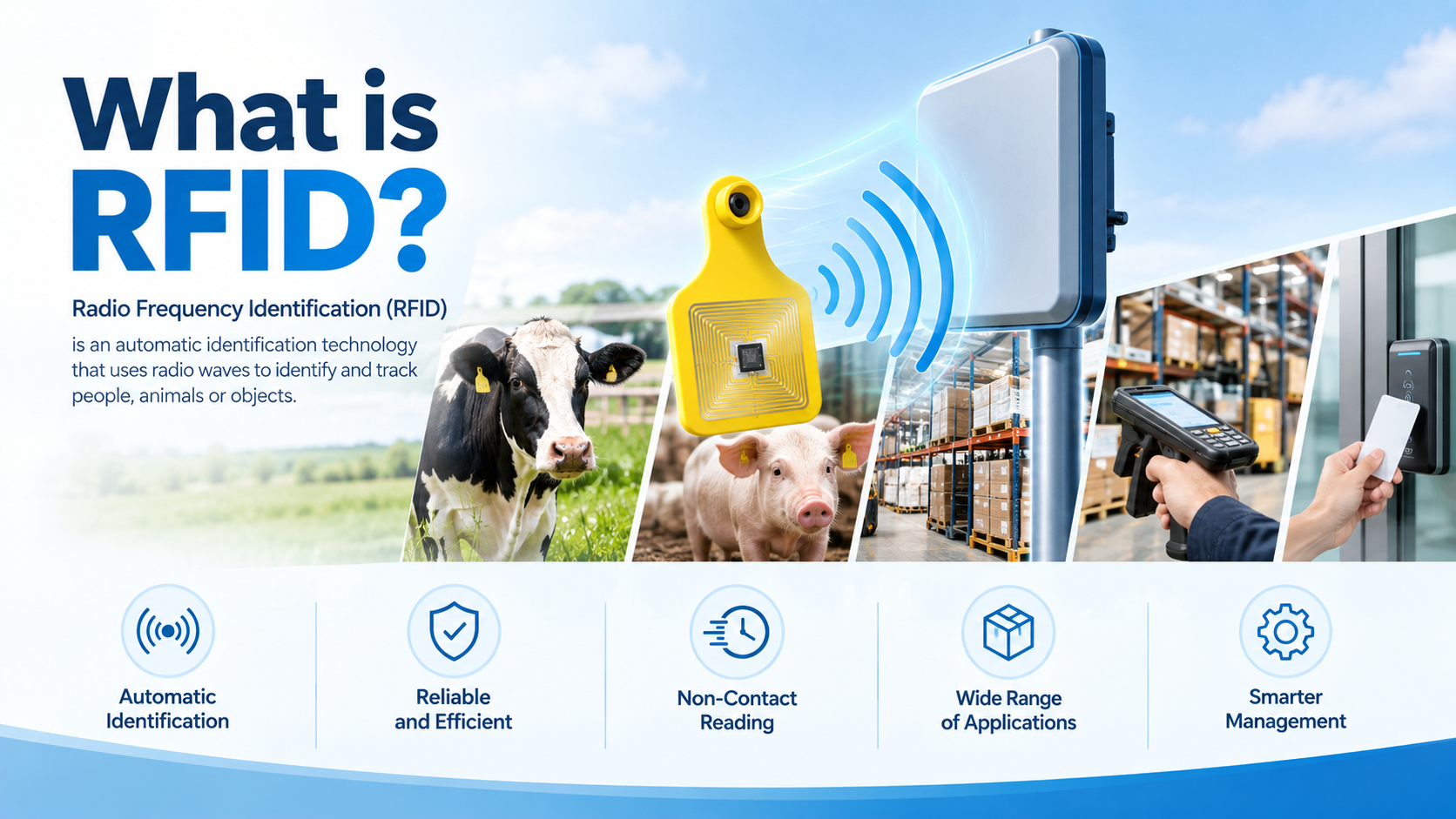
RFID stands for Radio Frequency Identification. It is an automatic identification technology that uses radio waves to identify and track people, animals, or objects.
Similar to other automatic identification technologies, such as barcodes, RFID enables information to be collected without requiring manual data entry for every identification process.
An RFID system typically consists of three main components:
RFID Tag: Stores identification information and communicates with the reader.
RFID Reader: Sends and receives radio signals to identify tags.
Antenna: Transmits and receives radio frequency signals between the tag and reader.
Depending on the application, RFID tags can be attached to products, embedded in objects, or used as animal identification tags.
For example, in livestock management, RFID ear tags can be used to identify individual animals and support data collection throughout their lifecycle.
2. How Does RFID Work?
RFID technology works through communication between an RFID tag and a reader using radio waves.
The basic process includes the following steps:
Step 1: The reader sends a radio frequency signal.
The RFID reader transmits a signal through its antenna to detect tags within its reading range.
Step 2: The RFID tag responds.
When an RFID tag enters the reader's operating range, it communicates with the reader. Depending on the tag type, it may use energy from the reader's signal or its own power source.
Step 3: Data is transmitted to the reader.
The tag sends its identification information back to the reader through radio frequency communication.
Step 4: The system processes the information.
The reader transfers the collected data to a connected computer, mobile device, or management system for identification, tracking, and further analysis.
This automated process helps reduce manual recording and supports faster data collection.
Note: RFID communication methods vary depending on the frequency, tag type, and system design. Reading distance and performance depend on the specific application and operating environment.
3. Why Choose RFID Instead of Manual Data Recording?
Traditional data recording methods often rely on paper forms, handwritten records, and manual keyboard input.
While these methods may work for simple tasks, they can create challenges when businesses need to manage large amounts of information.
Common problems include:
Handwriting and readability errors
Data entry mistakes
Time-consuming manual recording
Additional paperwork and administrative work
Difficulties locating and updating records
By introducing RFID-based identification systems, businesses can automate parts of the data collection process.
Key Benefits of RFID
Improved Data Accuracy
Automated identification can reduce errors associated with manual transcription and data entry.
Faster Data Collection
RFID systems can help collect identification information more efficiently, depending on the reader and application.
Reduced Manual Work
Automating identification and recording tasks can reduce the amount of repetitive labor required.
Better Data Management
Collected information can be integrated into digital systems, making records easier to organize, access, and update.
These benefits make RFID a practical solution for businesses looking to improve operational processes.
4. RFID vs. Barcode: What Is the Difference?
Barcodes remain one of the most widely used identification technologies because they are affordable, simple to implement, and suitable for many applications.
However, RFID offers different capabilities that can be valuable in specific working environments.
Barcode Technology
Barcode systems generally require a scanner to visually read the printed code.
Their performance can be affected by:
Scratches or damage to the printed code
Dirt, dust, and grease
Poor printing quality
Reflections and lighting conditions
The need for a clear line of sight
Barcode scanning typically requires the scanner to be positioned so that it can visually access the barcode.
RFID Technology
RFID uses radio frequency communication rather than relying on visual scanning of a printed code.
Depending on the RFID system, its advantages may include:
1. Non-Contact Identification
RFID tags can be read without physically touching the tag.
2. Reduced Line-of-Sight Requirements
Many RFID systems do not require direct visual alignment between the reader and tag.
3. Application Flexibility
RFID can be used in environments where printed barcodes may be difficult to scan, provided that the tag, frequency, reader, and surrounding materials are suitable.
4. Digital Data Storage
RFID tags can store identification information, and certain tag types support additional data functions.
Is RFID Always Better Than Barcode?
Not necessarily.
Barcode technology may be a suitable choice for simple, low-cost applications. RFID can be more appropriate when non-contact reading, automated identification, or environmental durability is important.
The right technology depends on your application, operating environment, budget, and data requirements.
5. What Are the Main Applications of RFID?
RFID technology is used across multiple industries to improve identification and tracking processes.
Livestock Identification and Management
RFID plays an important role in modern livestock management.
RFID animal ear tags and other animal identification products can help farmers and livestock management organizations:
Identify individual animals
Maintain digital animal records
Support livestock tracking
Improve management efficiency
Facilitate data collection
When combined with RFID readers and management software, animal identification systems can support more organized and efficient farm operations.
Inventory and Asset Tracking
Businesses can use RFID to identify and track products, equipment, and other assets.
Potential applications include:
Warehouse management
Inventory control
Asset identification
Supply chain tracking
Logistics operations
Industrial Automation
RFID can be integrated into manufacturing and production systems to support automated identification and process management.
It may help businesses improve traceability and reduce repetitive manual identification tasks.
Access Control and Identification
RFID technology is also used in access cards, identification systems, and other applications that require electronic identification.
The specific functions depend on the tag type and system design.
6. How Can RFID Benefit Your Business?
Implementing an RFID-based identification and tracking system can support business efficiency in several ways.
Improve Operational Efficiency
Automated identification can reduce repetitive manual tasks and help employees collect information more efficiently.
Enhance Traceability
RFID systems can support the tracking of products, animals, and assets throughout relevant operational processes.
Reduce Data Recording Errors
By reducing manual transcription, RFID can help minimize certain types of recording mistakes.
Support Digital Transformation
RFID data can be connected to software platforms and management systems, helping businesses move from paper-based processes toward digital operations.
Improve Decision-Making
Accurate and accessible identification data can provide useful information for inventory management, livestock management, and operational planning.
The actual benefits depend on system implementation, application requirements, and the quality of the supporting processes.
7. Choosing the Right RFID Solution
Before implementing an RFID system, businesses should consider several important factors:
Operating Frequency:
Different RFID frequencies are suitable for different applications and reading requirements.
Reading Distance:
The required reading range depends on the application and the reader-tag configuration.
Environmental Conditions:
Tags and readers should be selected according to exposure to moisture, dust, chemicals, temperature changes, and mechanical stress.
Tag Design:
The tag's size, material, durability, and installation method should match the intended application.
System Compatibility:
RFID tags, readers, antennas, and software should be compatible with the intended system.
Selecting the right combination of components is essential for achieving reliable RFID performance.
Conclusion: RFID Is Supporting the Future of Identification
RFID technology provides a practical way to automate identification and data collection across a wide range of industries.
Compared with traditional manual recording and visual barcode scanning, RFID offers different capabilities, including non-contact reading and reduced line-of-sight requirements in suitable applications.
From livestock identification to inventory tracking and industrial automation, RFID can help businesses improve data collection, operational efficiency, and traceability.
Understanding RFID is the first step toward selecting the right identification solution for your business.
At HabweID, we focus on RFID and animal identification solutions designed to support the evolving needs of modern businesses. Choosing the right products and system configuration can help customers build more efficient and reliable identification processes.
 infohabweid@gmail.com
 +86 17757310372


